
Article by Dr Biplab Rath
The concept of Atmanirbhar Bharat, meaning “Self-Reliant India,” emerged as a comprehensive national vision aimed at strengthening India’s economic resilience, industrial capability, technological independence, and strategic autonomy. In the defence sector, this vision became particularly significant because national security is deeply connected with technological capability and industrial preparedness.
For decades, India remained one of the world’s largest importers of defence equipment. Dependence on external suppliers posed several risks, such as delays in wartime supply chains, dependence on foreign spare parts and maintenance, vulnerability to sanctions and geopolitical pressure, limited technology transfer, high import costs, reduced indigenous innovations, etc. The Atmanirbhar Bharat initiative introduced several important reforms in India’s defence ecosystem, like expansion of indigenous defence manufacturing, increased role of the private sector, defence procurement reforms, promotion of defence exports, investment in emerging technologies, etc.

Practical Test in Operation Sindoor
Although Atmanirbhar Bharat had already initiated defence reforms, Operation Sindoor became the first real-world practical test of these ideas. In the early hours of May 7, 2025, India executed a high-precision, tri-service military response codenamed Operation Sindoor. Triggered by a brutal terror attack on tourists in Pahalgam on April 22, which claimed 26 innocent lives, the operation marked a departure from traditional “strategic restraint”.
The mission was a swift, 22-minute strike targeting nine high-value terror hubs deep inside Pakistan and Pakistan-occupied Kashmir (PoK). Unlike previous strikes, this was a tri-service operation involving the Army, Navy, and Air Force, hitting targets hundreds of kilometres inside the mainland, targeting infrastructure belonging to Lashkar-e-Taiba (LeT) and Jaish-e-Mohammed (JeM) in strategic locations like Bahawalpur and Muridke. Over 100 terrorists were eliminated. Following a brief four-day escalation that included Pakistani drone strikes and Indian retaliatory strikes on radar installations in Lahore, a ceasefire was reached on May 10, 2025.
Operation Sindoor, therefore, stands at the intersection of two major transformations:
- The evolution of India’s military doctrine.
- The acceleration of defence self-reliance under Atmanirbhar Bharat.

The Strategic Shift in India’s Military Doctrine
For decades, India often relied on diplomatic pressure, economic signalling, and restrained military responses after major security provocations. The strategic assumption was that escalation control remained the highest priority.
Operation Sindoor demonstrated a significant doctrinal shift. India showed that:
- Precision retaliation would become an acceptable response.
- Terror infrastructure and hostile military assets could be targeted rapidly.
- Conventional military responses could be employed below the nuclear threshold.
- Escalation management and retaliation could coexist simultaneously.
This shift established a new deterrence framework: India would no longer absorb major provocations without imposing visible military costs. The operation redefined India’s strategic red lines.
Air Power as the Core of Modern Warfare
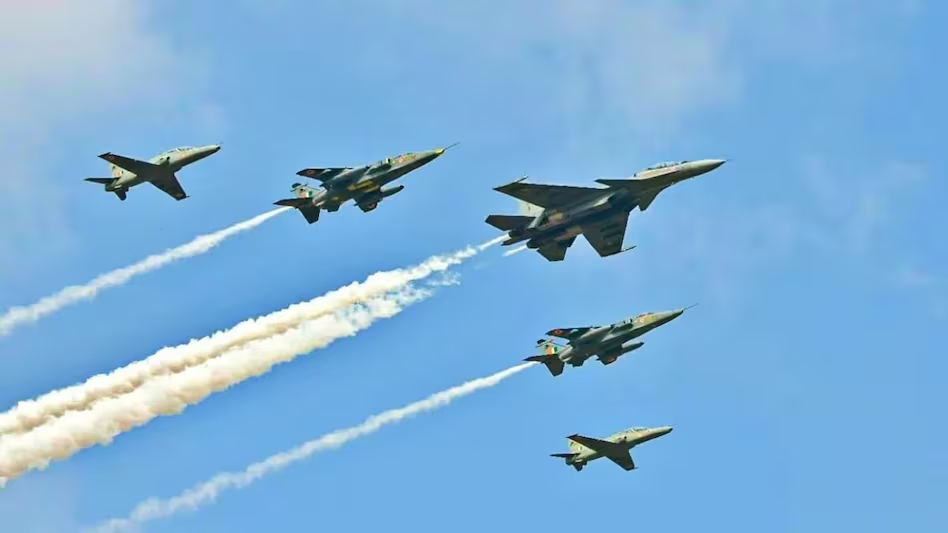
One of the most important lessons from Operation Sindoor was the central role of air power. Modern conflicts increasingly depend on precision-guided munitions, Stand-off missile systems, and air superiority. real-time intelligence, integrated surveillance networks, and beyond-visual-range strike capability. The operation reinforced the reality that future wars may be decided within hours or days through rapid precision strikes rather than prolonged ground campaigns. Air power provided several advantages, such as speed, political control over uncontrolled escalation, reduced casualties by using stand-off weapons, and impactful strategic signalling.
Using the lessons India focused on long-range precision strike capability, integrated air defence systems, advanced ISR platforms, indigenous missile developments, and network-centric warfare systems.
The Drone Warfare Revolution
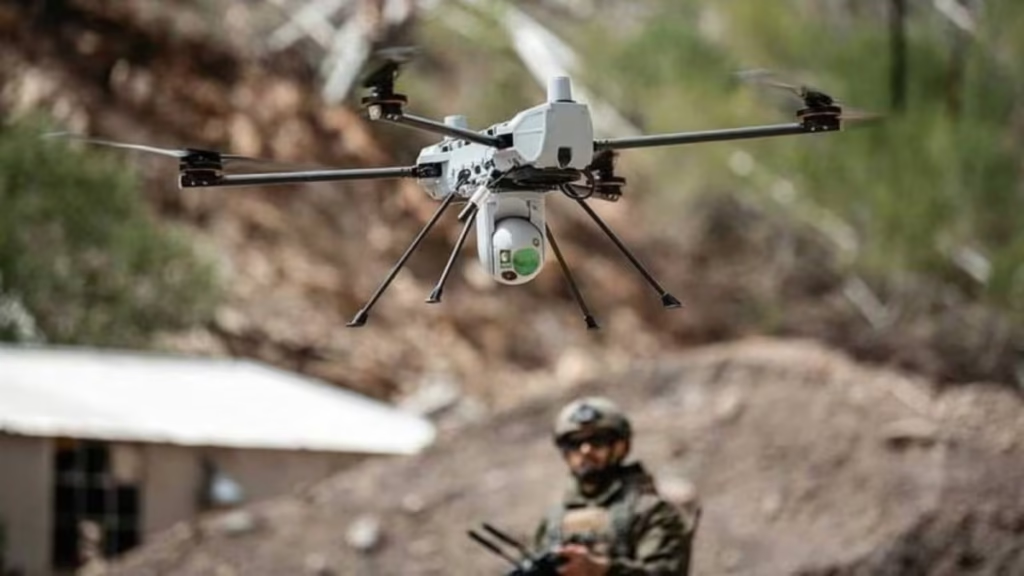
Operation Sindoor reinforced one of the biggest lessons from contemporary conflicts worldwide that cheap unmanned systems can impose disproportionate strategic costs. Drones proved valuable for surveillance, real-time battlefield intelligence, precision strikes, loitering munition attacks, target designation, and battle damage assessment. Key lessons learned about drone warfare were persistent surveillance for situational awareness, the effectiveness of loitering munitions, the effectiveness of swarm drones, and reduced risk to personnel in dangerous missions.
After Operation Sindoor, India accelerated indigenous UAV manufacturing, counter-drone technologies, AI-enabled autonomous systems, drone swarm programs, tactical battlefield drones, high-altitude long-endurance UAVs, and indigenous loitering munitions.

Electronic Warfare and Cyber Lessons
Operation Sindoor revealed that modern battlefields are heavily dependent on electromagnetic dominance. Military planners recognised gaps in electronic warfare systems, signal disruption capabilities, counter-jamming resilience, secure battlefield communications, GPS-denied operational capability, low-altitude radar coverage, and counter-UAV detection. The operation showed that sophisticated adversaries could disrupt communications, navigation systems, air defence coordination and battlefield networks.
Cyber warfare emerged as a critical battlefield dimension. Modern military operations depend heavily on secure communication networks, satellite systems, intelligence databases, air defence software, power infrastructure, and logistics networks. Any vulnerability in these systems can weaken operational effectiveness.
India, therefore, accelerated investments in cyber defence units, indigenous encryption systems, secure military networks, AI-driven cyber monitoring, offensive cyber capability, and data security infrastructure.

Jointness and Multi-Domain Warfare
Operation Sindoor highlighted the importance of coordination between armed forces, cyber units, intelligence agencies, space-based surveillance systems and most importantly, civilians. Modern warfare increasingly demands synchronised operations across multiple domains. It leads to a faster decision-making process, better and quick intelligence sharing, efficient resource utilisation, and multi-layered pressure on adversaries.
The operation strengthened arguments for theatre commands to integrate battle management systems, joint logistics infrastructure, unified targeting systems, and cross-domain operational doctrines.

Information Warfare and Narrative Control
Operation Sindoor demonstrated that battlefield success alone is insufficient. Narrative control became equally important. Governments must now manage international perception, media narratives, social media discourse, diplomatic signalling, public morale, and counter-disinformation operations. Information warfare can influence global diplomatic support, domestic political stability, international legitimacy, economic confidence, and psychological pressure on adversaries.
As a result, India invested more heavily in strategic communication systems, information monitoring, digital media response mechanisms, and counter-disinformation capabilities.
Atmanirbhar Bharat and Operation Sindoor
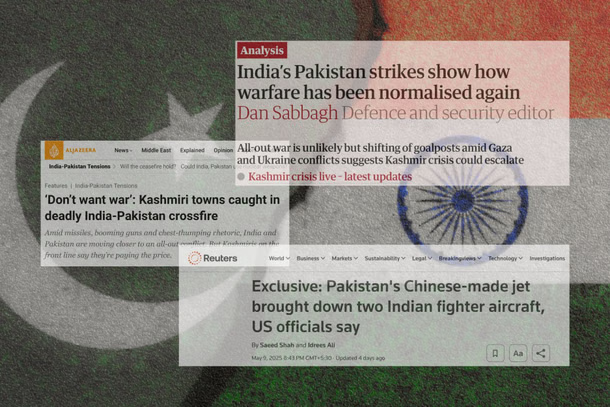
The operation highlighted a critical national security reality: dependence on foreign defence suppliers creates strategic vulnerability during crises. Wars require continuous ammunition supply, rapid availability of spare parts, access to electronic components, missile replenishment, software updates, and maintenance support. If these systems rely heavily on foreign suppliers, operational readiness may be compromised during geopolitical tensions.
Operation Sindoor, therefore, became a practical validation of Atmanirbhar Bharat. Self-reliance was no longer viewed only as an economic development objective. It became a strategic imperative and military and geopolitical necessity.
Defence Manufacturing Reforms After Operation Sindoor
Faster Procurement Systems
India accelerated reforms to reduce delays in military acquisitions. Key changes included faster emergency procurement, simplified acquisition procedures, increased domestic sourcing requirements, greater private-sector participation, and expanded indigenous production targets. Priority sectors included drones, missiles, air defence systems, radars, electronic warfare platforms, communication systems, and ammunition manufacturing.
Rise of the Private Defence Sector
Operation Sindoor demonstrated that innovation cycles in modern warfare are extremely rapid. Traditional state-run defence manufacturing alone cannot always adapt quickly enough. India recognised that future military superiority depends heavily on the speed of innovation, software capabilities, autonomous systems, AI integration, and semiconductor resilience. As a result:
- Defence startups gained greater government support.
- Private firms entered advanced defence manufacturing.
- AI and robotics companies became increasingly relevant.
- Indigenous software development received higher priority.

Supply Chain and Logistics Lessons
Operation Sindoor reinforced that high-intensity conflicts consume enormous quantities of precision munitions, drone systems, electronic components, missiles, fuel, spare parts, and communication equipment.
India, therefore, focused on strategic stockpiling, domestic manufacturing ecosystems, ammunition reserve expansion, indigenous component production, and supply chain localisation.
Technological Transformation After Operation Sindoor
The operation accelerated India’s transition from manpower-heavy warfare toward technology-intensive warfare. Key technological priorities include Artificial Intelligence, autonomous systems, Space-Based surveillance, Integrated Air Defence, Indigenous Missile Systems, Electronic Warfare Platforms, and Network-Centric Warfare.
Economic Impact of Defence Self-Reliance
Atmanirbhar Bharat in defence is not only about military strength. It also contributes to employment generation, industrial growth, technology development, research and innovation, export opportunities, semiconductor development, and startup ecosystem expansion. The defence sector increasingly became linked with advanced manufacturing, AI development, space technology, electronics production, and cybersecurity industries. This integration strengthened India’s long-term strategic and economic resilience.
Global Strategic Implications
Operation Sindoor demonstrated India’s growing ability to conduct precision operations, manage escalation, integrate modern technology into warfare, maintain strategic autonomy, and project credible deterrence. It also strengthened India’s image as a technologically capable military power with a rapidly modernising defence state and as a country seeking strategic independence. The operation increased international interest in:
- Indian defence manufacturing.
- Joint defence partnerships.
- Technology collaboration.
- Defence exports.
Key Lessons Learned from Operation Sindoor
- Precision Warfare Is the Future
- Air and Drone Dominance Are Critical
- Electronic and Cyber Warfare Are Central
- Joint Operations Are Essential
- Information Warfare Shapes Global Perception
- Indigenous Manufacturing Is Strategic Security
- Technology Is the Decisive Battlefield Advantage
Challenges Ahead
Despite progress, India still faces major challenges.
- Dependence on Imported Components
- Research and Development Gaps
- Technology Transfer Limitations
- Need for Skilled Workforce
- Long Procurement Cycles
Addressing these challenges will determine the long-term success of Atmanirbhar Bharat in defence.
Conclusion
Operation Sindoor became far more than a military operation. It acted as a strategic warning, a technological wake-up call, a doctrinal transformation point, a validation of defence self-reliance.
The operation demonstrated that future conflicts will not be won merely through conventional force size. Victory will increasingly depend on precision strike capability, indigenous defence production, AI-enabled warfare, drone systems, cyber resilience, electronic warfare superiority, multi-domain integration and rapid decision-making. Atmanirbhar Bharat, therefore, evolved from an economic slogan into a strategic national security doctrine.
The lessons of Operation Sindoor accelerated India’s transition toward a modern, technologically advanced, self-reliant military power capable of operating effectively in the rapidly changing landscape of 21st-century warfare.
Ultimately, the operation reinforced one central reality: National security in the modern era depends not only on military courage, but on technological independence, industrial capability, innovation, and strategic preparedness.
Views are those of the Author(s)
