India’s Quiet Management of the West Asia Crisis
Article by Prof. Kamal Madishetty
Three weeks into the escalating US–Israel–Iran conflict, the most visible story has been one of military confrontation and geopolitical brinkmanship. Less visible, but no less consequential, has been the economic and energy fallout, and how countries like India have navigated it.
For India, the stakes are immediate and structural. Nearly 85–90 per cent of its crude oil is imported, a significant share of which comes from West Asia. Liquefied natural gas (LNG) supplies, remittance flows from millions of Indian workers in the Gulf, and critical maritime trade routes passing through the Strait of Hormuz all tie India’s economic stability closely to the region. As tensions escalated, so too did risks: oil prices surged, LNG markets tightened, shipping insurance costs rose, and fears of supply disruption loomed large.
Yet, rather than reacting with disruption, India’s response has been marked by speed, diversification, and quiet diplomacy.
The most visible shift has been in crude sourcing. As disruptions mounted in the Gulf, Indian refiners rapidly pivoted toward alternative suppliers. Within less than two weeks, Indian companies secured roughly 30 million barrels of Russian crude, rerouting supplies through the Red Sea to bypass Hormuz-related risks. This adjustment was subsequently accommodated by Washington through a temporary waiver, underscoring a pragmatic recognition that sustaining global energy flows required flexibility toward major importers like India.
At the same time, the government emphasised that India maintains a strategic buffer of approximately 50 days of crude and fuel reserves, providing critical breathing space during supply shocks. More importantly, India’s long-term diversification strategy — expanding its sourcing network to nearly 40 countries, including Angola, Brazil, Colombia and the Republic of Congo — ensured that no single disruption translated into systemic vulnerability.
If crude oil posed one challenge, LPG posed another, more immediate one. Nearly 90 per cent of India’s imported LPG typically transits through the Strait of Hormuz, making it particularly exposed to disruption. As tensions escalated, several shipments were delayed or stranded.

Here, the government combined diplomacy with domestic intervention. Through direct engagement led by External Affairs Minister S. Jaishankar, India secured safe passage for LPG carriers such as the Shivalik and Nanda Devi, which successfully crossed the Strait and delivered over 90,000 metric tonnes of cooking gas to Indian ports. These deliveries were fast-tracked through dedicated “green corridors” to ensure rapid distribution.
Simultaneously, domestic measures were activated. The government invoked provisions akin to the Essential Commodities framework to prioritise household consumption, ensuring that cooking gas supplies remained uninterrupted for ordinary citizens. Commercial consumption, including sectors such as fertilisers and industry, was temporarily curtailed.
Refineries were instructed to ramp up LPG output, reportedly increasing production by as much as 25 per cent. Emergency cargoes were also sourced from alternative suppliers, including Australia, Canada and Norway. To prevent panic buying, refill booking intervals were extended, and price increases were absorbed to shield consumers from inflationary shocks.
These were not dramatic headline-grabbing moves, but they were effective. At no point did India face a visible household-level fuel crisis, which is a notable outcome given the scale of disruption in global energy markets.
Maritime risk, meanwhile, required a different kind of response. The Strait of Hormuz, through which a large share of India’s oil imports flows, became a zone of heightened tension, pushing up insurance premiums and freight costs. Indian authorities engaged with international partners to address insurance cover uncertainties while increasing maritime vigilance.

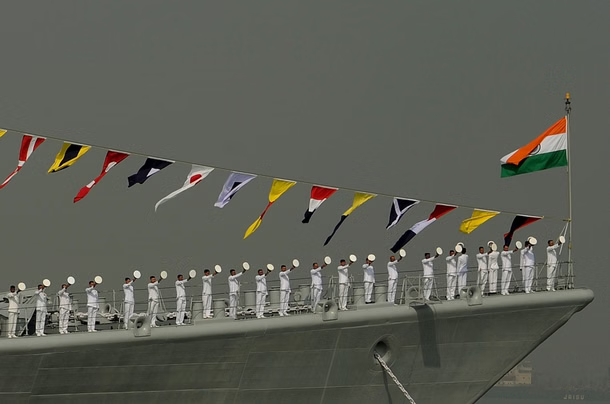
The Indian Navy stepped up deployments in the region, monitoring sea lanes and escorting Indian-bound vessels where necessary. This ensured continuity in shipping even as global insurers recalibrated risk assessments. The rise in marine insurance costs, effectively a “war premium” on shipping, did increase transaction costs, but did not translate into supply disruption.
Beyond energy, the economic risks were equally real. Higher crude prices threaten inflation, widen the current account deficit, and strain household budgets. LNG disruptions, particularly from Qatar, have become an even sharper concern following recent attacks affecting critical gas infrastructure in the region. Remittance flows from the Gulf, which contribute over $100 billion annually, also remain a potential vulnerability.
Here again, India’s approach was one of mitigation rather than reaction. By stabilising supply chains, avoiding panic policy responses, and maintaining diversified sourcing, the government prevented external shocks from translating into domestic instability. Indian refiners and public sector energy companies played a critical role in this adjustment, recalibrating procurement strategies in real time.
Underlying these economic measures has been a carefully calibrated diplomatic strategy. India has maintained engagement with all key actors — Israel, Iran and Gulf states — while consistently calling for de-escalation. Notably, New Delhi has avoided rhetorical escalation, refraining from explicitly aligning with any one side while prioritising stability, energy security and the safety of its diaspora.
This is strategic autonomy in practice. Rather than treating neutrality as passivity, India has used it as a framework for active balancing: engaging multiple actors while protecting core economic interests.
The results are visible. Despite one of the most volatile regional crises in recent years, India has avoided major supply disruptions, maintained fuel availability, and contained the immediate economic fallout.
At the same time, the crisis has underscored structural vulnerabilities. India remains heavily dependent on imported energy, leaving it exposed to global price shocks. Maritime chokepoints such as the Strait of Hormuz continue to represent strategic risks. Even diversified sourcing has limits when global markets tighten simultaneously.
Yet, the past three weeks also demonstrate that preparedness matters. Investments in diversification, strategic reserves, diplomatic channels and maritime capabilities have created a buffer that did not exist a decade ago.
Going forward, much will depend on the trajectory of the conflict. A prolonged escalation could further tighten energy markets and sustain elevated prices. Even in a stabilisation scenario, the geopolitical risk premium is likely to persist.
For India, the task is not to eliminate exposure, which is structurally impossible, but rather to manage it. That is precisely what New Delhi has attempted to do: secure supplies, stabilise markets, protect consumers and maintain diplomatic flexibility. The response has been incremental, often understated, but strategically coherent. In a crisis defined by volatility, that may be the most effective approach of all.
Views are those of the Author(s)


